How to choose a network for a token
A network is the place the contract will exist. Future Constructor deploys a standard ERC-20 on one of five live networks: Ethereum, Polygon, BNB Chain, Arbitrum, or Base. What that contract counts, and which functions it has, is in what an ERC-20 token is. This page does not rank the five networks, and it does not say what a token will be worth.
The costly mistake is a network your wallet cannot pay for, or telling people the token is “on crypto” without a network name. The address works on the network you signed. It does not travel with the name.
What you are choosing
You are choosing where the contract is created, which coin pays gas, and which service fee applies. You are not choosing a price, a listing, or a market. The form is the same kind of form on every network: name, symbol, and supply. They stay as you sign them.
The five live networks
There is no testnet. A lower service fee is still a live-network deploy, and the transaction is final.
| Network | Service fee | Coin for gas | Page |
|---|---|---|---|
| Ethereum | $6 | ETH | Ethereum |
| Polygon | $3 | POL | Polygon |
| BNB Chain | $3 | BNB | BNB Chain |
| Arbitrum | $3 | ETH | Arbitrum |
| Base | $3 | ETH | Base |
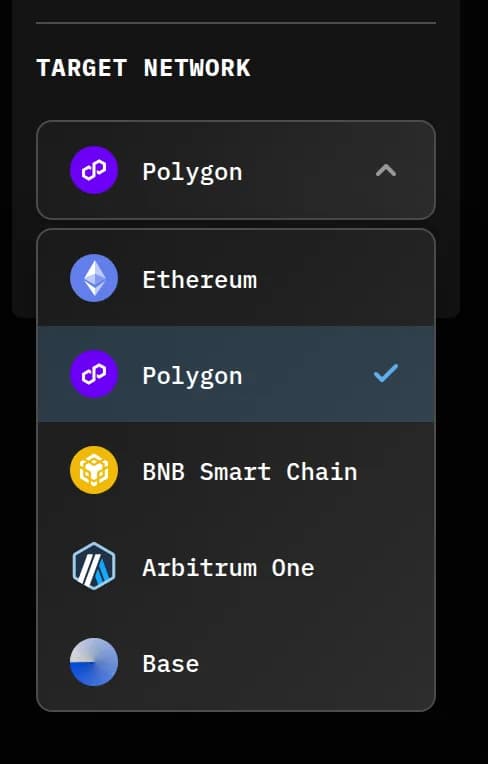
ETH on Ethereum, ETH on Arbitrum, and ETH on Base share a ticker. They are not the same balance. A wallet set to Ethereum does not pay gas on Base or on Arbitrum. Switch the wallet to the network you picked, and hold that network’s coin before you sign.
The service fee is not the gas
You pay two different things. The service fee is $6 on Ethereum and $3 on Polygon, BNB Chain, Arbitrum, and Base. It is not refundable. The form converts that dollar amount into the network’s coin via Chainlink. Gas is extra: the network’s own fee, shown in the wallet when you sign. It moves. This page does not quote gas in dollars.
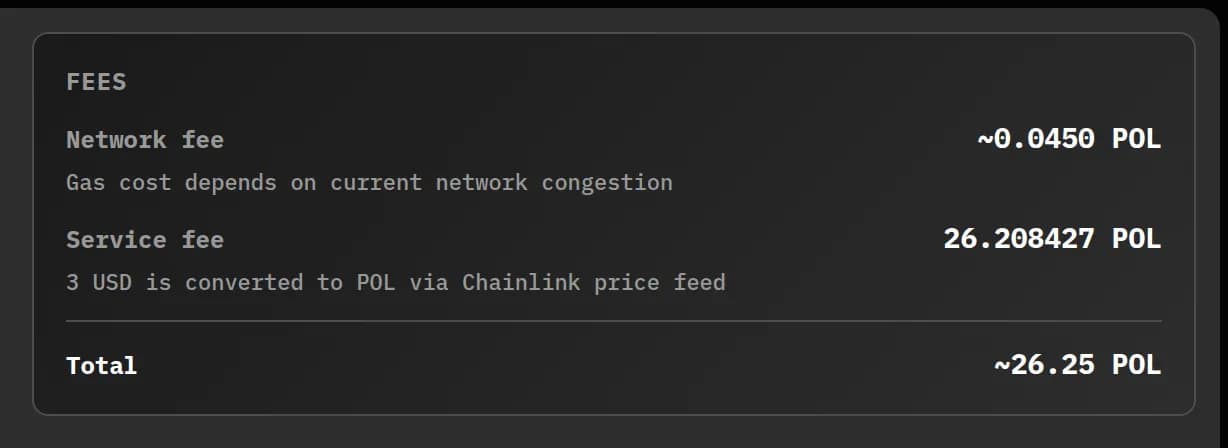
A $3 service fee does not set the gas, and it does not pick the network for you.
A second network is a second contract
Deploy creates one contract on the network you picked. It does not copy that contract onto another network. A second network is a second deploy: another signature, another service fee, another gas payment, and another address. Tell people the network and the address together.
A deployed token has a public page with the network, the contract address, and the supply. That page is not a price and it is not a listing. The path is /en/token/{chain}/{address} and /ru/token/{chain}/{address}. Add the token in the wallet by address, with the wallet on that same network.
How to read that page, the explorer, and a source match is in how to check that a deployed token is real. What a stranger checks before trusting that address is in how to make people trust your new token.
The token contracts are built on OpenZeppelin Contracts v5. Factory source code is verified on Sourcify. That is a match between the factory’s published source and the code on the network. It is not a review of your token, and it is not a security review. There has been no independent audit. The risk stays with you.
Where the wallet already opens
A practical check, not a ranking: where does the wallet already open, and which coin can you put in it before you sign? MetaMask is a common one. Constructor does not hold the wallet and does not ask for the seed phrase. A private message that asks for the phrase is not the product.
If the people who will hold the token already use a wallet on Polygon, a contract on Ethereum is a different place, even when the only numbers in front of you are $6 and $3. The same is true the other way. Those amounts are the service fee. They are not a score.
Outside the product, a swap screen is a habit, not a button here. On Base and Arbitrum the screen people usually mean is Uniswap. On BNB Chain it is often PancakeSwap. On Polygon it is often Uniswap or another swap site on that network. A pool is a separate step you take yourself. It needs two coins. You choose the size. After the address exists, liquidity basics and the rest of that work are in what to do after you deploy a token.
Checklist before you pick
- Write who holds the token. If the sentence is a future price, rewrite it.
- Name one of the five live networks. There is no testnet.
- Put that network’s coin in the wallet, and set the wallet to that network.
- Separate the service fee from gas: $6 on Ethereum, $3 on the other four. Gas moves.
- Assume a second network means a second contract and a second address.
- After you sign, save the address and the network name together.
Open a network, or the launch path
Open the live page for the network you are considering:
The ten-point path from the purpose sentence to the contract address is how to launch a token step by step.
When the sentence, the network, and the two fees are decided, open the form and create the token.
FAQ
Which network should I pick?
This page does not rank the five. Pick the live network where the wallet already opens and where you can hold the coin that pays gas. The service fee is $6 on Ethereum and $3 on the other four. That difference is not a score.
Why is the service fee $6 on Ethereum and $3 elsewhere?
Those are the two service fees the product charges: $6 on Ethereum, $3 on Polygon, BNB Chain, Arbitrum, and Base. The fee is not refundable. It is not a gas quote.
Does a $3 service fee mean the gas is $3?
No. Gas is separate. It moves, and the wallet shows it when you sign. This page does not quote gas in dollars.
Can I deploy on a testnet first?
No. There is no testnet. A $3 network is still a live deploy, and the transaction is final.
If I deploy on one network, does the token exist on another?
No. A second network is a second contract: another signature, another service fee, another gas payment, and another address.
Which coin pays gas?
ETH on Ethereum, POL on Polygon, BNB on BNB Chain, and ETH on Arbitrum and on Base. The ticker ETH is shared. The balance is not. The wallet has to be on the network you picked.
Has there been an independent audit?
There has been no independent audit. The token contracts are built on OpenZeppelin Contracts v5. Factory source code is verified on Sourcify. The risk stays with you.
Does choosing a network list the token or set a price?
No. The choice places one contract on one network. A pool, a catalog, and an exchange application stay with you. The public page shows the network, the address, and the supply. It is not a price.
Future Constructor is a technical tool. It deploys a standard ERC-20 from your own wallet on Ethereum (service fee $6) or on Polygon, BNB Chain, Arbitrum and Base (service fee $3). Network gas is extra and changes. The contracts use OpenZeppelin Contracts v5.4.0 and have not had an independent audit. Nothing on this page is financial, investment, or legal advice. You are responsible for the token’s purpose and for the laws that apply to you. Service fees are non-refundable. Transactions are final.