What to do after you deploy a token
The signature leaves a contract on one network. The work after that is a use, a community, a 30-day plan, and plain facts about liquidity and partners. This page does not promise a price or a profit.
The signature leaves one contract on one network, and the supply on the wallet that signed. It does not leave customers, a community, a pool, or a price. The work after that is yours. This is not financial advice.
The ten points from a purpose sentence to that address are in how to launch a token step by step. This page starts when the address already exists. It is about the month after launch, not about a button in the product. The written plan for the work before the signature, and for the first four weeks, is in how to make a launch plan for your token.
Realistic ways to earn, and the ways that are not
The contract does not pay you. It counts balances. What an ERC-20 balance is, including decimals, is in what an ERC-20 token is. Money, if any, comes from a product, a service, or a community you run. The token is how a person uses that thing. This page does not promise you will earn anything. Most new tokens are not used. You can finish every section below and still earn nothing.
Three patterns are real. None of them sets a swap price.
- Product use. You run a product. The token is a credit, a ticket, or a key inside it. A person pays for the product, in the network’s coin, in another coin, or off the chain, under the rules where you live. If nobody pays, the token does not create the payment. People sometimes call the credit “utility”. Here that word means one finished action inside the product. It is not a reason for a stranger to buy.
- A service you perform. A class, a repair, a membership period. The token shows who is in that period, or you account for the work in units you defined. The fee is for the work. If nobody hires you, the token does not fill the gap.
- A community you host. The token marks who is in the group. You might charge for an event or for a period of membership. The charge is for that event or that period. It is not a share of trading profit.
This page will not call the following earning:
- Telling strangers the price will rise, or naming a profit, a multiple, or a date.
- Buying your own token so a chart looks active.
- A yield or staking line you cannot point at a product a person can finish.
- Paying someone to post a profit.
- Taking money from the public for the token and calling that payment “utility”.
If the payment is really “send money, the token will be worth more later”, stop. That is a price promise. Securities laws and other rules may apply where you live. This is not legal advice. You are responsible for those laws.
How that money is counted, what the token is not, and which small community, club, or game can hold, is in how a project with a token earns. This section is the short list. That page is the economy. It does not repeat the month.
Build an audience and a community
An audience is people who can repeat what the token is for. A community is those people in one place where they can reply. A follower count, a holder count, and a chat full of bought accounts are numbers. Treat a bought number as empty.
Start with people who already fit the sentence, on the network you signed. How to ask for the first one, and why a bought list is empty, is in how to get the first holders for your new token. Your own signing wallet is the supply, not the audience.
Pick one place they can reply. You choose the place. Constructor does not host the chat and does not run the group. Post the purpose and the contract address there. When someone asks the price, repeat the purpose and say you do not set a price. Show up on the days you wrote down. A quiet week is a fact. Fill it with the next block of the plan, not with a bought crowd.
Do not buy followers, holders, reactions, or a package that promises a crowd. Do not paste your seed phrase into a tool that offers to grow the group. Constructor does not ask for the phrase. A private message that asks for it is not the product.
A 30-day plan after the address exists
This is a list of work for the first thirty days. It is not a forecast. Doing every row does not create buyers, a price, or income. Skipping a row does not break the contract. You can spend the month and earn nothing.
| Days | Do this | Leave out |
|---|---|---|
| 1–7 | Save the network, the contract address, and the transaction hash together. Write one sentence: who uses the token, and what they do with it. Tell people who already fit that sentence. Transfer only to someone who asked. | A future price. A bought list of holders. A launch party as proof of use. |
| 8–14 | Pick one place those people can reply. Post the sentence and the address there twice. Publish the token source on the explorer, or say that you have not. | A follower count as proof. A claim that someone reviewed the project. |
| 15–21 | Run one use a person can finish: access, a credit inside a product you run, or a community action. Write down who finished it, in words a stranger can check. | A chart. A return. A second token to “restart” the first. |
| 22–30 | If those people need a swap, decide about a pool using the liquidity section. If you talk to a partner, send the address, the sentence, and who already used the token. | A pitch built on a price target. A paid introduction you cannot describe. |
Keep the sentence the same in the chat, in the profile, and on the public page. If a row produces no person, write that down too. An empty row is a result. It is not a reason to invent holders.
Liquidity basics
A pool is optional. The deploy did not open one. Open one only if people who already use the token need to swap it. A V2 pool is two coins on a swap site. You choose both coins and both amounts. The pool lets a swap happen. It does not set what the token will be worth later, and it is not a listing. This page does not tell you to open a pool, and it does not tell anyone to buy.
On Ethereum, Polygon, Arbitrum, and Base the V2 screen is Uniswap. Connect the wallet that holds the tokens, set it to the token’s network, and choose a new v2 position. A v3 or v4 position is a different pool. This page is about v2. On BNB Chain the V2 screen is PancakeSwap, at pancakeswap.finance/v2/add, with the wallet on BNB Chain. Paste the contract address. A search by name can open a different contract. Constructor does not open either site.
The two amounts are the first deposit. Traders see that ratio. The ratio is not a price stored in the token contract, and it is not a price this page says the token will keep. Approve, then supply. Each of those is a transaction. Gas is extra. It is not the $6 or $3 service fee you already paid for the deploy.
After the pool transaction confirms, the wallet receives an LP token. On Uniswap V2 that token is often labeled UNI-V2. It is your share of that pool. It is not your project token. Constructor does not take it, does not store it, and does not lock it. Whoever holds the LP token can remove that share. If you send it away, that person can pull the coins. A lock, if you want one, is outside the product. Do not type your seed phrase into a site or a chat that offers to lock the position for you.
If people trade, the two balances move. The coins you can withdraw later can differ from the coins you put in. That difference can be a loss. A V2 pool can also pay the position a share of swap fees. Neither fact is income this page promises. A large deposit is not a reason to buy. An empty pool is not a hole this page will fill. You can lose the coins you deposit.
| Network you signed | Service fee, already paid | V2 pool you open yourself |
|---|---|---|
| Ethereum | $6, plus gas in ETH | Uniswap V2. Choose a new v2 position. |
| Polygon | $3, plus gas in POL | Uniswap V2. The wallet must be on Polygon. |
| BNB Chain | $3, plus gas in BNB | PancakeSwap V2, at pancakeswap.finance/v2/add. |
| Arbitrum | $3, plus gas in ETH | Uniswap V2. The wallet must be on Arbitrum. |
| Base | $3, plus gas in ETH | Uniswap V2. The wallet must be on Base. |
Finding investors and partners
This page does not find investors or partners, and it does not describe a return. A partner, here, is a person or a project that uses the token for the sentence you wrote, or that introduces people who fit that sentence, for a reason you can write in one line. Paying them a share of a hoped-for price is not that. An investor conversation, if you have one, is about the product or the community. It is not a target price.
You find them the same way you find the first holders: people who already do the thing the token is for. Do not buy a list of investors. Do not pay a stranger who writes to you offering introductions, exchange listings, or “market making” in exchange for an upfront fee or your seed phrase. Constructor does not send those messages.
The questions to write down before that conversation are in what an investor will ask about your token. The answers are facts. A future price is not one of them.
Until they ask a specific question, send only this:
- The purpose sentence: who uses the token, and what they do with it.
- The network and the contract address, together.
- Where the supply sits. On a standard deploy it is the wallet that signed.
- Who has used the token, by name or by the action they finished. If nobody has, say so.
- Built on OpenZeppelin Contracts v5; factory source code is verified on Sourcify; no independent audit.
Leave out a future price, a profit, a multiple, and any line that says the project was reviewed. They can say no. A no does not mean the contract failed. If you take money from the public for the token, or you sell a share of a project, securities laws and other rules may apply where you live. This is not legal advice.
| You can say | Leave out |
|---|---|
| Who the token is for, and what they do with it | A future price, a profit, or a multiple |
| Network and contract address together | The token name alone |
| Who already used it, or that nobody has | A bought holder count |
| No independent audit, and where the supply sits | A claim that the project was reviewed |
Build trust with facts a stranger can check
Trust, on this page, is a short list a stranger can check without taking your word. The longer list is in how to make people trust your new token. Clearing the list does not mean someone should buy.
Say the same facts in the chat, in a partner note, and on the public page. Where the supply sits. What holders can do. That there has been no independent audit. A published token source means anyone can read that source. It is not a review of the project. If you have not published, say so. Matching the address you signed is in how to check that a deployed token is real.
The creator profile is text and links you save. The page labels them “Provided by the token creator, not verified”. Do not tell people the block was checked. A pool, a holder count, and the service fee are not reviews. The fee was the charge for the deploy. It was not a certificate.
On this product, after the signature
Constructor’s part is already done: one standard ERC-20 on one of five live networks, Ethereum, Polygon, BNB Chain, Arbitrum, or Base. There is no testnet. The supply starts on the wallet that signed. A second network is a second signature, a second service fee, and a second address. The product does not find users, open a pool, lock an LP token, or introduce a partner.
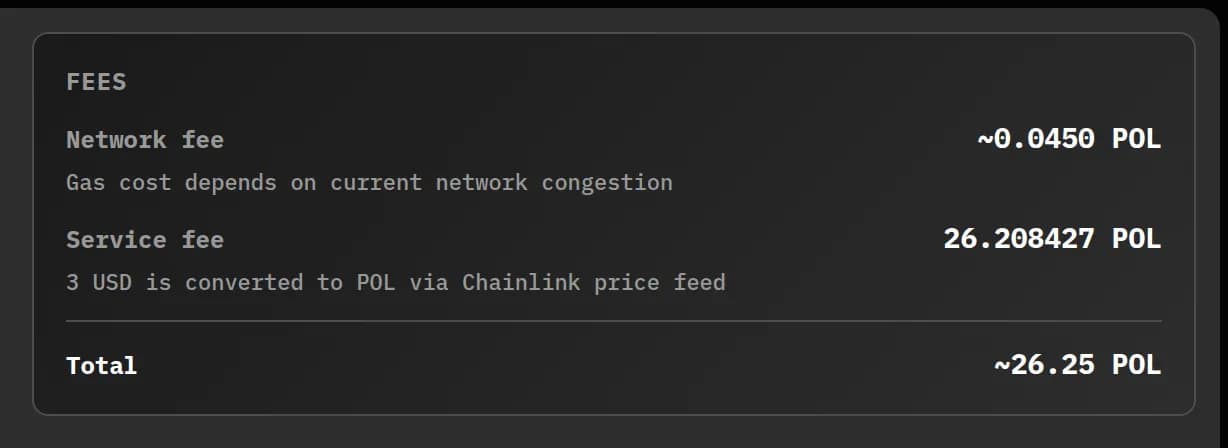
You already paid the service fee: $6 on Ethereum and $3 on Polygon, BNB Chain, Arbitrum, and Base. It is not refundable. Gas was extra, in that network’s coin. Neither amount bought a community, a pool, or a partner. How the two amounts differ is in how to choose a network.
A deployed token has a public page at /en/token/{chain}/{address} and /ru/token/{chain}/{address}. The chain slug is eth, polygon, bnb, arbitrum, or base. Read it the way a stranger will: network, contract address, and supply. The note under the facts names the source, the TokenCreated event from the factory and the transaction receipt. The page is not a price and it does not open a pool.
On that page the creator sees four next steps: publish the code in the explorer, share the link, submit a logo through the explorer’s token update form, and fill the profile. A pool is not on that list. That is the product’s part. The rest of this page is work the product does not do.
The risk stays with you
You can lose the service fee, the gas, and any coins you put in a pool, and still have no users. The token can sit unused. A swap price can go to nothing. This page does not predict either outcome, and it does not tell anyone to buy.
Whoever holds the LP token can remove that share of a pool. Constructor does not lock it. The contract still has whatever owner functions the public page already lists. A community post does not remove them.
Built on OpenZeppelin Contracts v5; factory source code is verified on Sourcify; no independent audit. Sourcify is a match for the factory’s published source and the factory code on the network. It is not a review of your token or of what you tell people. The risk stays with you.
Checklist for the first 30 days
- Write the use. If the sentence is a price or a profit, rewrite it.
- Save the network, the contract address, and the transaction hash together.
- Days 1 to 7: tell people who fit the sentence. Transfer only to someone who asked.
- Days 8 to 14: one place they can reply. Post the address twice. Publish the source, or say you have not.
- Days 15 to 21: one finished use. Write down who did it. If nobody did, write that down.
- Days 22 to 30: a partner note is the facts, not a price. A pool is optional, and you open it yourself.
- Say that there has been no independent audit. Do not call the service fee a certificate.
- Do not buy an audience. Do not hand anyone your seed phrase.
Where to go next
The other guides are on Learn. Matching the deploy you signed is in how to check that a deployed token is real. What a stranger can check is in how to make people trust your new token. The first person who holds the token is in how to get the first holders for your new token. The network and the two fees are in how to choose a network. What the product deploys, and what it leaves out, is in the lite paper. Users, a pool, and partners are outside that page.
If you have not signed yet, the form is the deploy. The month on this page is still later.
FAQ
Does deploying the token pay me?
No. The contract counts balances. The service fee is money you already paid: $6 on Ethereum or $3 on Polygon, BNB Chain, Arbitrum, and Base, plus gas. It is not income, and it is not refundable. You can do the work on this page and still earn nothing. This is not financial advice.
What are realistic ways to earn with the token?
Three patterns, and none is a promise. A product that uses the token as a credit, a ticket, or a key. A service you perform. A community event or membership you host. The payment is for that product, service, or event. It is not a rising swap price, and it is not a profit this page promises. Most new tokens are not used.
Does a community make people buy?
No. A community is people who can repeat what the token is for and reply to you. It is not a buyer list. A bought chat is a number. This page does not tell anyone to buy.
What does the 30-day plan promise?
Nothing about price, holders, or income. It is a list of work for the first month after the address exists. Doing every line can still leave you with no users. Skipping a line does not break the contract.
Does Constructor add the liquidity?
No. A pool is a later step you take on a swap site, and only if the people who use the token need a swap. On Ethereum, Polygon, Arbitrum, and Base that V2 screen is Uniswap. On BNB Chain it is PancakeSwap V2. Constructor does not open either one, and it does not lock the LP token.
Will this page find investors or partners?
No. It does not introduce them, and it does not describe a return. You talk to people who already fit the purpose, and you send the network, the address, and what holders can do. If you take money from the public for the token, securities laws and other rules may apply where you live. This is not legal advice.
Does a public page or a pool mean the token was reviewed?
No. Built on OpenZeppelin Contracts v5; factory source code is verified on Sourcify; no independent audit. A public page and a pool are not a review of the project. The risk stays with you.
Can I tell people the price will rise?
No. The contract does not store a price or a profit. If the sentence is a future price, rewrite it. Say what a person can do with the token. This page does not tell anyone to buy. This is not financial advice.
Future Constructor is a technical tool. It deploys a standard ERC-20 from your own wallet on Ethereum (service fee $6) or on Polygon, BNB Chain, Arbitrum and Base (service fee $3). Network gas is extra and changes. Built on OpenZeppelin Contracts v5; factory source code is verified on Sourcify; no independent audit. Nothing on this page is financial, investment, or legal advice. You are responsible for the token’s purpose and for the laws that apply to you. Service fees are non-refundable. Transactions are final.