How to make people trust your new token
“How do I make people trust it?” usually means the name is ready and the stranger is not. A name is not the token. Two contracts can share one. On this page, trust is the short list a stranger can check without taking your word. The list does not make the token a purchase. This is not financial advice.
The costly miss is a promise the contract cannot keep: a future price, a profit, or a line that someone reviewed the project. None of those sit in the code.
What “trust” means here
A stranger can repeat four facts. The source they can read. The page and the profile, with the label that the profile is yours. Where the supply sits. The sentence about what holders can do with the token. Anything past that list is a claim you are making, not a fact the chain is showing.
The product does not award a badge for this list. The service fee is $6 on Ethereum and $3 on Polygon, BNB Chain, Arbitrum, and Base. It is the charge for the deploy. It is not refundable, and it is not a certificate. Gas is extra, shown in the wallet when you sign. There is no testnet. The contract lives on one of the five live networks. How to pick that network is in how to choose a network.
Publish the source
People often say the source is “verified” when an explorer shows readable code. On the public page the line is “Code in explorer”: published, or not published. Published means anyone can read the source. The line under that fact says the same thing: anyone can read it, and it is not a review of the project.
Publishing is optional. “Not published” does not, by itself, mean the contract is fake. It is a gap a stranger can see. If you have not published, say so, and send the transaction hash with the network and the address. How to match the network, the address, and the fields you signed is in how to check that a deployed token is real.
Built on OpenZeppelin Contracts v5; factory source code is verified on Sourcify; no independent audit. Sourcify is a match for the factory’s published source and the factory code on the network. The explorer line is about your token contract. Neither one is a review of your project. The risk stays with you. Do not write that the token was reviewed.
The page and the profile
A deployed token has a public page. The path is /en/token/{chain}/{address} and /ru/token/{chain}/{address}. The chain slug is eth, polygon, bnb, arbitrum, or base.
Read it the way a stranger will. Network, contract address, supply, the creation transaction, and whether the explorer has published source. The note under the facts names where those facts come from: the TokenCreated event from the Constructor factory, and the transaction receipt. The page is not a price and it is not a listing.
The creator profile is text and links you add after deploy. Only the wallet that created the token can save them. That wallet opens /en/token/{chain}/{address}/edit and the same path under /ru. On the public page the block is labeled “Provided by the token creator, not verified”. Do not tell people the block was checked.
Write what holders can do with the token, in the short description. Point them at one place that repeats the same network and the same address: a site, X, or a Telegram channel you control. A profile that is not empty needs that description, a category, and at least one of those links. Do not put a price in the text. Do not paste a seed phrase anywhere on the page.
The supply and the wallets
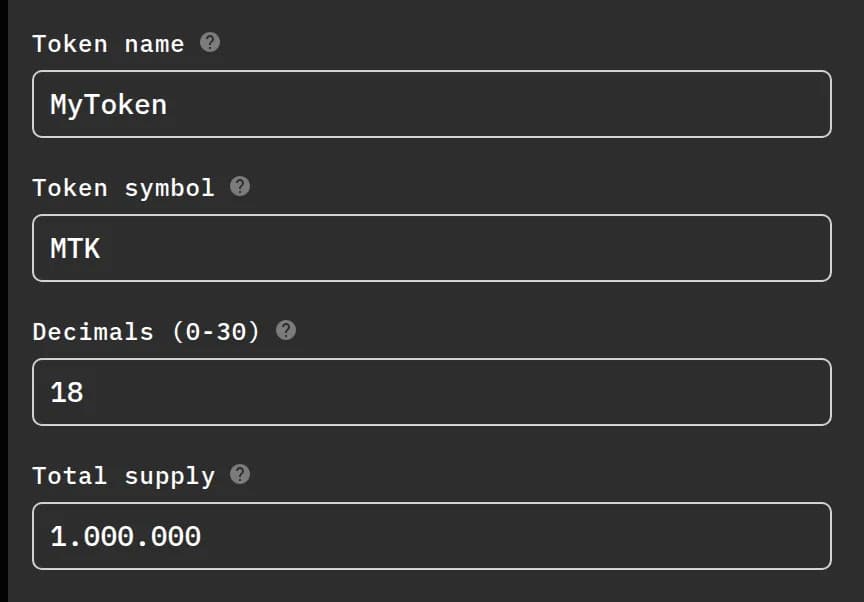
On the standard form, the supply starts on the wallet that signs. The public page says who received it. The explorer lists holders. If that address is yours, say so in the profile. If another wallet holds a share you call a team wallet, name the address. An unnamed pile is a red flag people already look for. Naming the wallet is a fact. It is not a promise that the tokens will be worth more later.
Also read the contract line. On a standard token, “no mint, pause, or fee” is a property of that code. It is not a review of the project. If the page lists owner functions, those functions are in the code. Say them in the same sentence as the supply. A stranger who finds a mint function you never mentioned will treat the silence as the problem.
Say the use, not a price
Write who holds the token, and what they can do with it. Access, points, a meme, or an experiment can fit that sentence. If the sentence is “the price will go up”, or any profit, delete it. The contract does not store it, and this page does not support it.
Send the network and the address together. A shared name, or a shared ETH ticker, is not a shared contract. Another network is another signature and another address. The path from that sentence to the address is how to launch a token step by step.
That same sentence is what you send before an investor call. The other questions, and the lines to leave out, are in what an investor will ask about your token.
Where the project’s money comes from, and the money mistakes that break this sentence, are in how a project with a token earns.
A pool is two coins
Deploy does not open a pool. A pool, if you make one, is a later step on a swap site. It needs two coins. You choose the size. A pool lets a swap happen. It does not set what the token will be worth later, and it is not a listing. This page does not tell you to open a pool, and it does not tell anyone to buy. Liquidity basics, and the other work after the address exists, are in what to do after you deploy a token.
Strangers look at three plain facts: whether a pool exists, which wallets still hold the supply, and whether your sentence matches the contract. Those facts are not a recommendation. A large pool is not a reason to buy. An empty one is not a reason this page will invent.
Red flags a stranger already looks for
This list is what people compare with your message. Clearing it does not mean someone should buy. It means the facts they know how to check are not hidden.
| What they see | Why it costs the conversation |
|---|---|
| The name of a known asset, and a different address | The name is not the identity. The identity is the network plus the address. |
| The explorer has not published source, and you do not say so | They cannot read the code. Say that, or publish it. |
| One wallet holds the supply, with no sentence about whose it is | An unnamed pile is the check they already know. |
| A chat names a future price or a profit | The contract does not store that. The page should not either. |
| A message says the project was reviewed | There has been no independent audit. Do not claim one. |
| A private chat asks for the seed phrase | Constructor does not ask for the phrase. That message is not the product. |
| The network is missing from the message | Another network is another contract, even when the ticker looks familiar. |
Checklist before you tell anyone
- Save the network, the contract address, and the transaction hash together.
- Publish the token source on that network’s explorer, or say that you have not.
- Open the public page and read the network, the address, and the supply as a stranger would.
- Fill the profile from the creator wallet. Keep the label: the text is yours, and it is not verified.
- Name the wallet that holds the supply. Name a team wallet if there is one.
- Write the use. If the sentence is a price or a profit, delete it.
- If you open a pool, say the two coins and the size. Do not call the pool a promise.
- Send the network and the address. Do not send a future price, and do not ask anyone for a seed phrase.
Where to go next
The other guides are on Learn. Matching the deploy you signed is in how to check that a deployed token is real. The ten-point path is how to launch a token step by step. The five networks, the service fee, and the gas coin are in how to choose a network. What the product deploys, and what it leaves out, is in the lite paper.
When the sentence is a use, not a price, and the network is chosen, create the token with Future Constructor.
FAQ
Does deploying the token make people trust it?
No. Deploy creates one contract on one network. A stranger still has to check the address, the published source, the supply, and what you say. A deploy is not a review of the project.
Is a published source the same as an independent audit?
No. Built on OpenZeppelin Contracts v5; factory source code is verified on Sourcify; no independent audit. Published source means anyone can read that source. It is not a review of your project. The risk stays with you.
What does the creator profile prove?
It shows text and links saved by the wallet that created the token. The page labels them “Provided by the token creator, not verified”. The label means the block is not a review.
The whole supply sits on one wallet. Should I stay quiet about it?
Say so. On a standard deploy the supply starts on the wallet that signed. An unnamed pile is one of the things a stranger already looks for. Naming the wallet does not set a price.
Can I tell people the price will rise?
No. The contract does not store a price or a profit. If the sentence is a future price, rewrite it. Say what holders can do with the token. This page is not financial advice.
Does a liquidity pool mean people should buy?
No. A pool is two coins on a swap site. You choose whether to open one and how large it is. It is not a listing and not a reason to buy. This page does not tell anyone to buy.
Does the $6 or $3 service fee prove the token?
The service fee is $6 on Ethereum and $3 on Polygon, BNB Chain, Arbitrum, and Base. It is the product’s charge for that deploy. It is not a certificate. Gas is separate and moves.
Someone asks for my seed phrase so they can “check trust”. Is that Constructor?
No. Constructor does not ask for the seed phrase. A private message that asks for the phrase is not the product. Do not type the phrase into a site or a chat.
Future Constructor is a technical tool. It deploys a standard ERC-20 from your own wallet on Ethereum (service fee $6) or on Polygon, BNB Chain, Arbitrum and Base (service fee $3). Network gas is extra and changes. The contracts use OpenZeppelin Contracts v5.4.0 and have not had an independent audit. Nothing on this page is financial, investment, or legal advice. You are responsible for the token’s purpose and for the laws that apply to you. Service fees are non-refundable. Transactions are final.