What is an ERC-20 token
An ERC-20 token is a contract that keeps a list of balances. The list has a name, a short symbol, a decimals setting, and a supply. Wallets and other contracts read that list through a small set of functions every ERC-20 shares. The standard does not set a price, and it does not place the token anywhere people trade. This page is not financial advice.
Future Constructor deploys one of these contracts from your wallet. The service fee is $6 on Ethereum and $3 on Polygon, BNB Chain, Arbitrum, and Base. Gas is extra and it moves. There is no testnet, so the signature is on a live network and it is final.
What an ERC-20 is
ERC-20 is a shared interface, not a coin by itself. A wallet can ask any compliant contract the same questions: what is your name, how many units exist, how many does this address hold, and will you move units if asked. Ethereum, Polygon, BNB Chain, Arbitrum, and Base use that interface. The contract you deploy still lives on the one network you sign.
“Token” here means the units that contract counts. It does not mean a price, a company share, or a buyer. If you need one sentence for the people who will hold the units, write what they can do with them. If the sentence is a future price, rewrite it. The contract cannot keep that promise, and this page will not make it.
A familiar name does not make the contract a well-known asset. The identity is the network plus the address. Two contracts can share a symbol and still be unrelated.
The standard functions
You do not call these by typing them. A wallet does. Together they are the public surface of a plain ERC-20. Amounts are integers of the smallest unit, not the number a person usually says out loud.
| Function | What it does |
|---|---|
name | Returns the name you signed. |
symbol | Returns the short ticker you signed. |
decimals | Returns how many digits sit to the right of the point. |
totalSupply | Returns how many smallest units exist. |
balanceOf | Returns how many units one address holds. |
transfer | Moves units from the caller to another address. |
approve | Lets another address move up to this many of your units. |
allowance | Returns how many units that permission still covers. |
transferFrom | Moves units by using a permission from approve. |
approve is the function people skip. Another contract cannot take units from your address until your address has approved a limit. The limit is a count of raw units, not a dollar amount. You choose the address and the size. Nothing moves until that address calls transferFrom. A limit for an address you do not recognize can still be spent.
Decimals and the supply
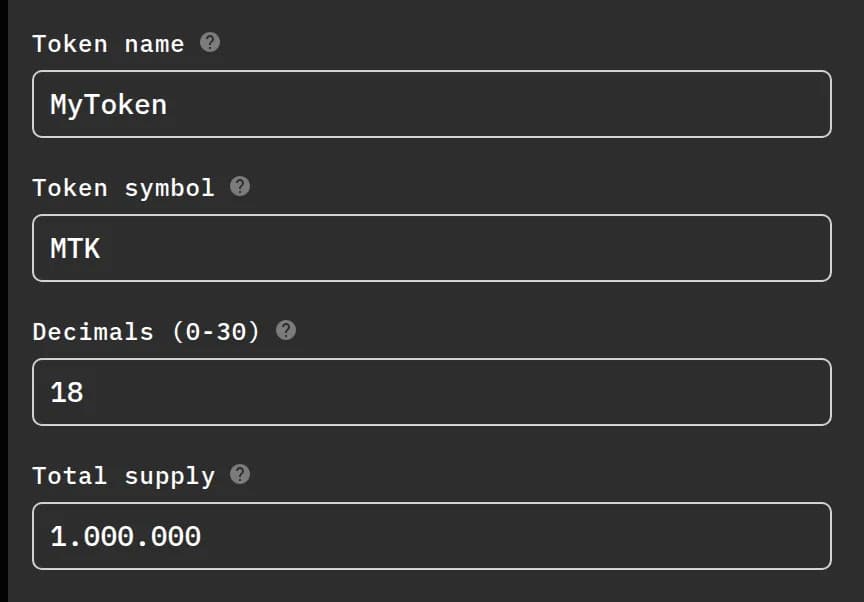
The form asks for a whole number of tokens and a decimals value from 0 to 30. The contract stores the supply in the smallest units. It multiplies the number you type by 10 to the power of decimals. 18 is the usual value, and it is the form’s starting value. Decimals 0 means the contract cannot represent a fraction of one token.
| You type | Decimals | Units the contract stores |
|---|---|---|
| 1000 | 18 | 1000 × 10^18 |
| 1000 | 6 | 1000 × 10^6 |
| 1000 | 0 | 1000 |
A wallet that reads decimals divides before it shows the balance, so 1000 with 18 decimals looks like 1000. A screen that prints the raw integer shows a much longer number. The supply did not grow. The screen skipped the decimals.
transfer uses the same raw units. A call that sends 1 when decimals are 18 moves 0.000000000000000001 of a token, not one token. Wallets convert the number you type. A script that forgets the conversion does not.
The same typed supply with different decimals is not the same size on the chain. 1 with 18 decimals is 10^18 units. 1 with 6 decimals is 10^6 units. Pick the decimals before you sign. The standard contract does not change them later.
If the multiplication would overflow, the deploy does not go through. A huge typed supply combined with a high decimals value is the usual way to hit that limit. The form is asking for the human number, not the already-scaled integer.
What a Constructor token includes
The create form deploys this standard token. You set the name, the symbol, the decimals, the supply, and the address that receives the supply. You do not write the contract. The name and the symbol use Latin letters and digits. The symbol is 2 to 11 characters. They stay as you sign them.
The whole supply is minted once, to the address in the owner field. That field starts as the wallet that signs. On this standard contract the field is the recipient of the supply, not a role that can mint again. There is no later mint, no burn, no pause, and no fee taken on transfer. Sending tokens to other addresses changes who holds the units. It does not change totalSupply.
Built on OpenZeppelin Contracts v5; factory source code is verified on Sourcify; no independent audit. Sourcify verification means the factory’s published source matches the code on the network. It says nothing about the purpose of your token. The risk stays with you.
A separate extended form can add functions this standard token does not have: an admin mint, an admin burn, a pause on transfers, a fee on transfer, or a split of the initial supply. That is different code, and it is not the $6 or $3 deploy described here. The fee on that form is the amount the form shows before you sign. This page does not quote it.
On the standard form you pay two different things. The service fee is $6 on Ethereum and $3 on Polygon, BNB Chain, Arbitrum, and Base. It is not refundable. The form converts that dollar amount into the network’s coin via Chainlink. Gas is the network’s own fee, shown again in the wallet when you sign. A $3 service fee does not set the gas, and it does not pick the network for you. Which network, and which coin pays gas, is covered in how to choose a network.
After the deploy
You leave with a contract address on the one network you picked. The supply sits on the address you named. From then on, transfers talk to that token contract. They do not go back through the factory.
A deployed token has a public page with the network, the contract address, and the supply. That page is not a price and it is not a listing. The path is /en/token/{chain}/{address} and /ru/token/{chain}/{address}. Add the token in a wallet by that address, with the wallet set to the same network. Until you do, the wallet can show nothing even though the contract holds the supply.
Tell people the network and the address together. The name is not enough. The same name on another network would be another contract, another signature, another service fee, and another gas payment.
A pool, a catalog, and an application to an exchange are steps you take yourself, later, if they belong in your plan. Deploy does not file them, and this page does not name a venue to use. The ten-point path from the purpose sentence to the address is how to launch a token step by step.
Common mistakes
- Reading the number you typed as the raw unit count. The chain stores supply × 10^decimals.
- Choosing decimals 0 and then expecting to send a fraction of one token.
- Sending
1from a script and expecting one whole token when decimals are 18. - Expecting to edit the name, the symbol, the decimals, or the supply after the standard deploy.
- Treating the $6 or $3 service fee as the gas. Gas is separate, and a $3 network is still live.
- Sharing the name without the network and the address.
- Assuming one deploy exists on all five networks. A second network is a second contract.
- Approving an address you do not mean to use, or typing a seed phrase into a site or a private chat. Constructor does not ask for the phrase.
- Describing the token with a future price. The contract has no price. This is not financial advice.
Where to go next
The other guides are on Learn. Use how to choose a network before you pick one of the five, and how to launch a token step by step when the purpose sentence is ready. What a stranger can check on the address is in how to make people trust your new token.
The live network pages:
When the name, the decimals, the supply, and the network are decided, open the form.
FAQ
Is an ERC-20 only an Ethereum token?
The interface was written for Ethereum. The same functions work on other EVM networks. Future Constructor deploys on Ethereum, Polygon, BNB Chain, Arbitrum, and Base. A contract still exists on only one of them.
Why does a wallet show a different number than the raw balance?
The contract stores whole units. A wallet divides by 10 to the power of decimals before it displays the balance. With decimals 18, a raw balance of 1000 × 10^18 is shown as 1000.
Can I change the name or the supply after the standard deploy?
No. The standard contract mints the supply once, to the address you set, and it has no function that mints more, burns, pauses transfers, or edits the name, the symbol, or the decimals.
Does deploying an ERC-20 set a price or list the token?
No. Deploy creates the contract and a public page with the network, the address, and the supply. A pool, a catalog, and an exchange application are later steps you take yourself, if they are in your plan. This page is not financial advice.
What is approve for?
approve lets another address move up to a number of your units. The number is in raw units, not dollars. Nothing is spent until that address calls transferFrom. Set the limit only for an address you mean to use.
Has there been an independent audit?
Built on OpenZeppelin Contracts v5; factory source code is verified on Sourcify; no independent audit. The risk stays with you.
If I deploy on one network, does the same token exist on the others?
No. A second network is a second contract: another signature, another service fee, another gas payment, and another address. Share the network name with the address.
Is this page financial advice?
No. It describes how a standard ERC-20 counts balances. It does not say what a token will be worth, and it does not tell you to create one.
Future Constructor is a technical tool. It deploys a standard ERC-20 from your own wallet on Ethereum (service fee $6) or on Polygon, BNB Chain, Arbitrum and Base (service fee $3). Network gas is extra and changes. The contracts use OpenZeppelin Contracts v5.4.0 and have not had an independent audit. Nothing on this page is financial, investment, or legal advice. You are responsible for the token’s purpose and for the laws that apply to you. Service fees are non-refundable. Transactions are final.